
Friday, April 18, 2014
Collecting Your Own Reference

Class demos
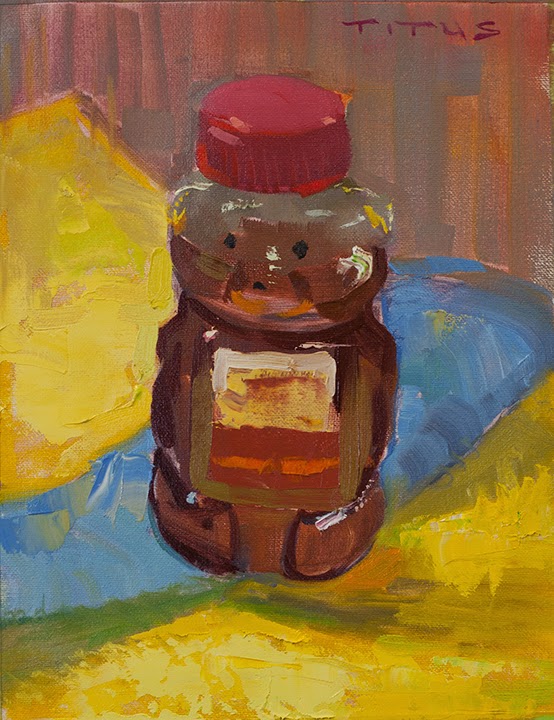 |
| Honey Bear, 10x8 inches |
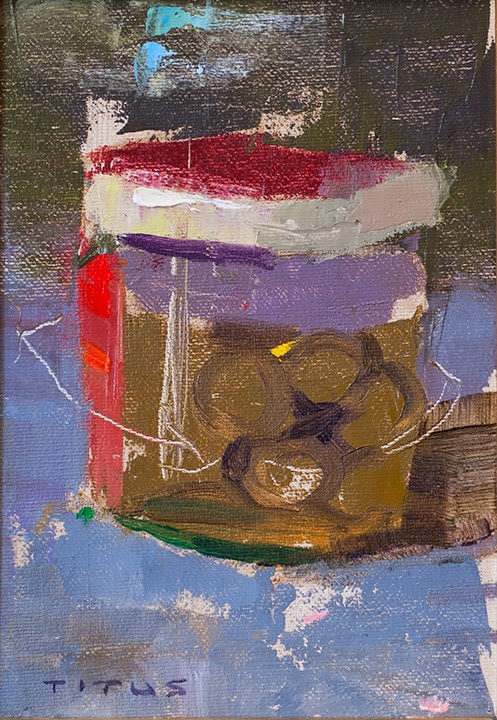 |
| Jar of Olives, 7x5 inches |
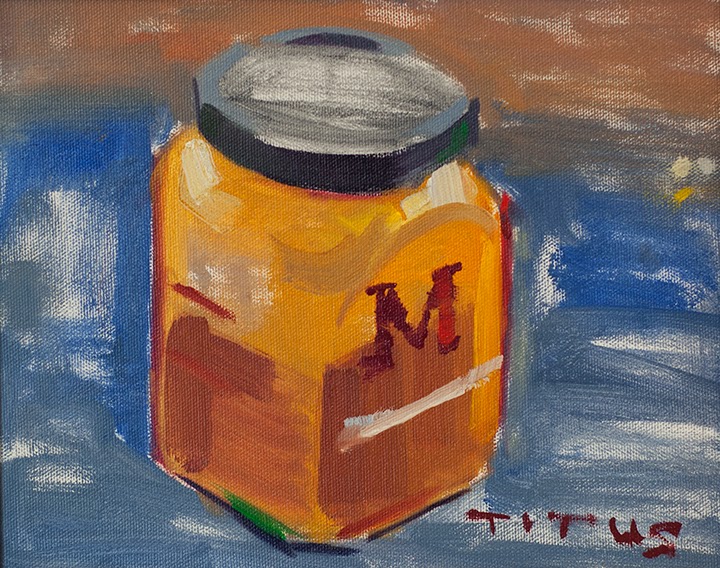 |
| Marmalade, 8x10 inches |
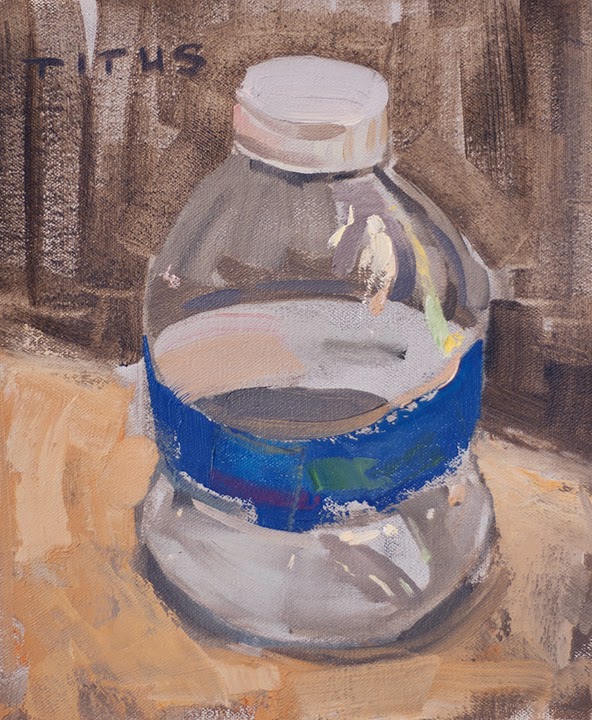 |
| Water Bottle, 10x8 inches |
Wednesday, March 5, 2014

Friday, January 17, 2014
Techniques for getting yourself painting again.

You're in that rut? That's not good.
Well, there's quite a lot you can do to get out of the rut if you put your mind to it. When I get like that I like to think about painting as something that is done for fun, for your enjoyment only and for pure leisure and escapism. Certainly don't make a big deal about the whole act and don't worry about rules or approaches that must be done. Your critic must be dissolved. Paint as if no one will ever see the painting. Anything you do will be received with great celebration by yourself. Paint using your child instincts and purely for the enjoyment of the act itself. Every stroke is a very fulfilling exploration of yourself and the thing your painting. If you paint trusting your child-self, where you are the only one with all the answers you'll ever need, then your artist voice will start to take over.
I also try to relax, experience life and think about things that inspire me to want to paint. They may be philosophies, inventions, people, places or things from my imagination. I draw a lot and develop this conversation in my sketchbooks. Paint or draw simple things or take complicated things (compositions) and make them simple.
I like to think of the things that I like and why I like them. Thinking about why you like something leads to greater awareness and deeper investigation.
Try writing. Write in your sketchbook or journal. Creating a blog for your artwork is a great place to focus on writing about your art in-depth. Writing helps me keep a dialog going about where I'm at with my art, the way I see the world and understanding my journey.
Try teaching. Show someone else whether a child or a classroom full of adults what you know about drawing, painting, sculpture or art in general. Verbalizing out loud what you know in front of an audience helps you make clear to yourself and others your approach and ideas about painting. You will also find that you will not have time for negativity and your critic will begin to dissipate.
Record your dreams immediately upon waking. Write down in detail in your journal or do a quick sketch in your sketchbook. You will surprise yourself. Your dream-inspired sketches are a more honest interpretation of your unsolicited inner voice.
Try writing. Write in your sketchbook or journal. Creating a blog for your artwork is a great place to focus on writing about your art in-depth. Writing helps me keep a dialog going about where I'm at with my art, the way I see the world and understanding my journey.
Try teaching. Show someone else whether a child or a classroom full of adults what you know about drawing, painting, sculpture or art in general. Verbalizing out loud what you know in front of an audience helps you make clear to yourself and others your approach and ideas about painting. You will also find that you will not have time for negativity and your critic will begin to dissipate.
Record your dreams immediately upon waking. Write down in detail in your journal or do a quick sketch in your sketchbook. You will surprise yourself. Your dream-inspired sketches are a more honest interpretation of your unsolicited inner voice.
Listen to music. Listening to music while you create or while you're not creating is a great engine. This usually gives way to me reasearching new and existing bands.
And, when I'm really at a road block in life, I like to listen to Gene Wilder's song, "Pure imagination":
Or, I'll try having a drink of beer or three. I'll listen to music and find new musicians that inspire a different state of mind or emotion. I also like spoken books or recordings of rants by artists, writers and poets.
I'll hang out with other artists and talk about art or things that inspire them. I like to hear their perspective and how they see things. I find their points of view are usually more optimistic than my own, and optimism, usually leads to greater in-depth thinking and discovery.
I'll work out at the gym or at home (but usually not while drinking). Practicing Yoga or just plain stretching can be a great way to awaken the muscles and refresh your physical body. And, having a moment or two through out each day to meditate--or really, just call it whatever you want. I like to call it listening and feeling the sun on my skin.
Read a book. I like to read many books on artists that talk about their life and art. I like to read whatever... Hemingway, F. Scott Fitzgerald, Kurt Vonnegut, or even a self help book about greater consciousness and awareness. The book I'm reading now is a book by Jon Kabat-Zinn, Wherever You Go There You Are. It talks about non-doing.
When I'm not quite in the mood to actually make art, I'll do things that are related to enabling the act. I'll build stretcher bars, stretch canvas, build frames, clean glass on existing pieces, take pictures of them or scan them, cut mat board, clean and organize my studio, or even shop for supplies online or in stores.
Collect reference. I bum around and take pictures with my camera of things that I like (buildings, people, whatever). I may even do a quick sketch of it as a way of documenting it as well.
Go for a hike and sketch along the way. Sketching isn't always necessary, sometimes just "taking-in" is all that is needed.
I also like to do non-art related activities, such as: fixing my car or house, cleaning my car and truck, studio or house, or doing something nice for someone else.
Go to museums or galleries where you can see the original works of art. I like to feel the energy the originals have, especially Rembrandt's. I also go to local art shows and gallery openings to support other artists.
I find that planning out my projects that I am going to work on sometimes helps. Having a clear picture of what you plan on setting out to do such as a series can help motivate you and steer you in a direction.
Go on Youtube and watch artists paint their pictures.
I find that planning out my projects that I am going to work on sometimes helps. Having a clear picture of what you plan on setting out to do such as a series can help motivate you and steer you in a direction.
Go on Youtube and watch artists paint their pictures.
I'm usually always researching obscure artists so that I may find a language that resonates with my own. I recently found an artist that I really like, Arthur Clifton Goodwin. In these, I look for new inspiring approaches that lead me to the sheer joy of painting.
Try looking at this great blog that I recently found. There are many great artists I've never even heard of and I'm sure they all went through the same tribulations.
http://bjws.blogspot.com
Also, don't forget to get proper amounts of sleep and nutrition. Sleep greatly affects creativity. It's one of the first things I check when I'm in a rut or depressed for that matter. I ask myself, Have I had something to eat? Have I been drinking water? Have I gotten my eight hours of sleep?
Also, don't forget to get proper amounts of sleep and nutrition. Sleep greatly affects creativity. It's one of the first things I check when I'm in a rut or depressed for that matter. I ask myself, Have I had something to eat? Have I been drinking water? Have I gotten my eight hours of sleep?
Tuesday, October 1, 2013
Investigating Light–As An Oil Painter Sees It
As an oil painter, understanding the basics behind the subject of light will help shed awareness on color mixing. This section is about identifying the temperature of light and how it impacts the use of white in your mixes.
When evaluating which colors to mix in response to a light source, it helps to first identify the source as being natural or artificial. This is because the two emanate distinctively different temperatures. As a general way of looking at it and for simplicity's sake, we can say that natural light is cool and artificial light is warm. Natural light (light coming from the sun) is generally whiter (cooler), or known as balanced light. Artificial light (man-made light or light bulbs) is generally warmer. Let's investigate both these scenarios.
How an artist sees light
Let's begin with natural light and how it impacts our color mixing.
Natural Light (light coming from the sun) is cool. This doesn't mean you're not going to use warm colors in your lights such as yellows, reds, oranges and warm browns. Yes, you will use these warm colors. However, you will use them with some amount of white added into the mix. This is called a tint or tinting a color. A tint is the mixture of a color with white. It is critical that a painter is aware of when white is added to a color you are automatically cooling-off and making less intense that color, it becomes a tint of that color. The color is in a way deadened or neutralized by adding white to it. It helps to think of white and black having the same neutralizing affect on color, they subdue color.
Artists refer to the temperature of natural light as being cool (this is, of course, an exception to sunrise and sunset). The brighter the sunlight, maybe too, the more white added and washed-out the color becomes. For instance, red is intrinsically warm. However, once white is added to it it then becomes a lighter tint of red and, as a consequence, it becomes cooler. Pink is just another name for a cool red. Instead of calling it "pink" an artist more accurately identifies it as being red with however much white added to it. The word "pink" is less descriptive and is really not as much use a term for an artist's vocabulary.
What is important is that the red's intensity has been lessened by the white. An artist now begins to more accurately make a distinction between the amount of red vs. the amount of white in the mix. This is valuable to a painter because a painter needs to be able to gauge the intensity of a color and how much white may be in it, its tint.
The science of light
Forget you are an artist painter for a moment. From a scientific perspective, natural light is generally refereed to as cool because the sun burns both extremely bright and hot, commonly known to artists as white light or perfectly balanced light (not too warm and not too cool).
Earth's atmosphere is why natural light is sometimes seen as a cool blue. Our dense atmosphere is made up of water particles that absorb most all the color bands of light, letting go of blue. This refracting and reflecting light is also what makes the ocean look blue. A brief exception occurs during sunrise and sunset. While the amount of light (Lumen) is slowly diminished during sunset, so too does the bright white light and it begins to warm to that of a candle before it's extinguished. The light that does remain has to pass through our dense atmosphere at a more extreme angle to the horizon—where the pollution also cares to dwell. Light passes through pollution particles and further contributes to a warm light cast. The opposite scenario is true... the hotter and brighter a light source gets the cooler the light is perceived.
Artificial light
Artificial light (light emitted by manmade light bulbs) is probably the most complicated of all the light sources because of the many different types of bulbs on the market. Although in the past artificial light was known as being warm. However, these days, the many different types of bulbs offered can be warm or cool or even in some cases, perfectly balanced. An artist must have an understanding of the different types of bulbs available and which ones are of use. Most bulbs lean on the side of warm or cool and usually not well balanced.
Bulbs
When shopping for light bulbs it is common to find the Kelvin listed but not the Lumen. Why? Lumen is a measurement gathered based on how for you are from the source. They couldn't possibly tell you the Lumen unless they knew how far away you were standing from the source, or how large the room is, or how much reflected light or other factors. Instead, manufacturers list the wattage of the bulb, i.e., the output based on how much energy the bulb uses. The more energy it consumes the brighter the bulb. They will also list the temperature output of the bulb in Kelvin. Artists generally look for bulbs that are 4,500-5,500 Kelvin. This number range is what represents an emulation of natural light. Any higher a value and the light becomes too cool. Any lower a value and the light becomes too warm.
An artist must be aware of the many types of light bulbs and their varying degrees of cool and warm. Energy saving bulbs give-off a violet cast, some a greenish cast and so-on. There is perfectly balanced lighting available however, none of it can be found at Home Depot or your local hardware store. Please see my blog post which talks about what types and brands are available.
Light measurements
Two units used for measuring light output are the amount of light being emitted (Lumen) and its temperature (Kelvin).
Lumen is the measurement used to describe the total amount of light emitted by a source based on the distance you are from the source, i.e, how bright something is based on how far away you are from it.
Kelvin is used for measuring temperature (how hot the output source). White light exists (as manufactured bulbs describe) around 5,500 Kelvin.
Another consideration to artists regarding bulb technology is the color rendering index (CRI) which is important information when purchasing higher-end bulbs, balanced bulbs. CRI has a percentage measurement from 1 to 100. 100 is the value closest to white light, otherwise known as natural light or perfectly balanced light, which is not too warm and not too cool. When looking to purchase studio lighting that emulates this natural white light, it is not hard to find inexpensive fluorescent T8 tube type bulbs having a CRI of 98%. Please refer to my light your studio section for more information.
CRI is a scale of measurement used to describe a light source's ability to reproduce the colors of various objects faithfully in comparison with an ideal or natural light source.
Lumen and Kelvin influence each other and contribute to the overall perceived value of a source's temperature and total light output. Too little Lumen and the light will become dimmer and warmer, like a candle. And, the more the Kelvin the more the light will be perceived as being brighter and cooler. The Sun is very hot and very bright. It has major amounts of both Lumen and Kelvin—so the light is very bright and white. Compare this to a candle which is very dim and very warm. In other words, very low in Lumen and Kelvin.
As incandescent bulbs are being phased-out they are being replaced by energy efficient Compact Fluorescent Light (CFL) bulbs. Artists are discovering that CFL's have some use in their studios because of their availability, low price and the cooler light output compared to that of an incandescent. Yes, these bulbs are cooler than incandescent but they do still emanate a sometimes blue, violet, orange or greenish tinge. However, this bulb technology is quickly improving and won't be long before it can produce a more useful balanced (white) light.
Until CFL's are improved, artists are finding that the most balanced light comes from designer fluorescent tubes (T8 tubes, 32 watt, 98% CRI). They cost about $10 each and they provide a balanced white light and are also known to help alleviate symptoms created by Seasonal Affective Disorder (SAD). The T8 tube is the bulb I would choose if I had only one choice. They do a great job with brightening the entire studio without having to deal with direct lighting and they last for years. In addition to the T8's, I sometimes use a Halogen or an incandescent bulb to warm-up the studio by carefully bouncing the light off a wall or ceiling.
Candle light is warm and produces a small amount of light. Low in both Lumen and Kelvin means warm in nature. Using the charts below, try figuring out where camp fire light would fit or where blue propane torch light would fit.
These charts will give you a better understanding of the temperatures produced by natural and artificial light sources. Like the color wheel, an artist should have these basic charts engrained in the brain. Study the charts. Keep in mind these charts provide values in Kelvin, not Lumens.
When you look at light, hopefully now, you'll think in terms of its intensity and temperature.


When evaluating which colors to mix in response to a light source, it helps to first identify the source as being natural or artificial. This is because the two emanate distinctively different temperatures. As a general way of looking at it and for simplicity's sake, we can say that natural light is cool and artificial light is warm. Natural light (light coming from the sun) is generally whiter (cooler), or known as balanced light. Artificial light (man-made light or light bulbs) is generally warmer. Let's investigate both these scenarios.
How an artist sees light
Let's begin with natural light and how it impacts our color mixing.
Natural Light (light coming from the sun) is cool. This doesn't mean you're not going to use warm colors in your lights such as yellows, reds, oranges and warm browns. Yes, you will use these warm colors. However, you will use them with some amount of white added into the mix. This is called a tint or tinting a color. A tint is the mixture of a color with white. It is critical that a painter is aware of when white is added to a color you are automatically cooling-off and making less intense that color, it becomes a tint of that color. The color is in a way deadened or neutralized by adding white to it. It helps to think of white and black having the same neutralizing affect on color, they subdue color.
Artists refer to the temperature of natural light as being cool (this is, of course, an exception to sunrise and sunset). The brighter the sunlight, maybe too, the more white added and washed-out the color becomes. For instance, red is intrinsically warm. However, once white is added to it it then becomes a lighter tint of red and, as a consequence, it becomes cooler. Pink is just another name for a cool red. Instead of calling it "pink" an artist more accurately identifies it as being red with however much white added to it. The word "pink" is less descriptive and is really not as much use a term for an artist's vocabulary.
What is important is that the red's intensity has been lessened by the white. An artist now begins to more accurately make a distinction between the amount of red vs. the amount of white in the mix. This is valuable to a painter because a painter needs to be able to gauge the intensity of a color and how much white may be in it, its tint.
The science of light
Forget you are an artist painter for a moment. From a scientific perspective, natural light is generally refereed to as cool because the sun burns both extremely bright and hot, commonly known to artists as white light or perfectly balanced light (not too warm and not too cool).
Earth's atmosphere is why natural light is sometimes seen as a cool blue. Our dense atmosphere is made up of water particles that absorb most all the color bands of light, letting go of blue. This refracting and reflecting light is also what makes the ocean look blue. A brief exception occurs during sunrise and sunset. While the amount of light (Lumen) is slowly diminished during sunset, so too does the bright white light and it begins to warm to that of a candle before it's extinguished. The light that does remain has to pass through our dense atmosphere at a more extreme angle to the horizon—where the pollution also cares to dwell. Light passes through pollution particles and further contributes to a warm light cast. The opposite scenario is true... the hotter and brighter a light source gets the cooler the light is perceived.
Artificial light
Artificial light (light emitted by manmade light bulbs) is probably the most complicated of all the light sources because of the many different types of bulbs on the market. Although in the past artificial light was known as being warm. However, these days, the many different types of bulbs offered can be warm or cool or even in some cases, perfectly balanced. An artist must have an understanding of the different types of bulbs available and which ones are of use. Most bulbs lean on the side of warm or cool and usually not well balanced.
Bulbs
When shopping for light bulbs it is common to find the Kelvin listed but not the Lumen. Why? Lumen is a measurement gathered based on how for you are from the source. They couldn't possibly tell you the Lumen unless they knew how far away you were standing from the source, or how large the room is, or how much reflected light or other factors. Instead, manufacturers list the wattage of the bulb, i.e., the output based on how much energy the bulb uses. The more energy it consumes the brighter the bulb. They will also list the temperature output of the bulb in Kelvin. Artists generally look for bulbs that are 4,500-5,500 Kelvin. This number range is what represents an emulation of natural light. Any higher a value and the light becomes too cool. Any lower a value and the light becomes too warm.
An artist must be aware of the many types of light bulbs and their varying degrees of cool and warm. Energy saving bulbs give-off a violet cast, some a greenish cast and so-on. There is perfectly balanced lighting available however, none of it can be found at Home Depot or your local hardware store. Please see my blog post which talks about what types and brands are available.
Light measurements
Two units used for measuring light output are the amount of light being emitted (Lumen) and its temperature (Kelvin).
Lumen is the measurement used to describe the total amount of light emitted by a source based on the distance you are from the source, i.e, how bright something is based on how far away you are from it.
Kelvin is used for measuring temperature (how hot the output source). White light exists (as manufactured bulbs describe) around 5,500 Kelvin.
Another consideration to artists regarding bulb technology is the color rendering index (CRI) which is important information when purchasing higher-end bulbs, balanced bulbs. CRI has a percentage measurement from 1 to 100. 100 is the value closest to white light, otherwise known as natural light or perfectly balanced light, which is not too warm and not too cool. When looking to purchase studio lighting that emulates this natural white light, it is not hard to find inexpensive fluorescent T8 tube type bulbs having a CRI of 98%. Please refer to my light your studio section for more information.
CRI is a scale of measurement used to describe a light source's ability to reproduce the colors of various objects faithfully in comparison with an ideal or natural light source.
Lumen and Kelvin influence each other and contribute to the overall perceived value of a source's temperature and total light output. Too little Lumen and the light will become dimmer and warmer, like a candle. And, the more the Kelvin the more the light will be perceived as being brighter and cooler. The Sun is very hot and very bright. It has major amounts of both Lumen and Kelvin—so the light is very bright and white. Compare this to a candle which is very dim and very warm. In other words, very low in Lumen and Kelvin.
As incandescent bulbs are being phased-out they are being replaced by energy efficient Compact Fluorescent Light (CFL) bulbs. Artists are discovering that CFL's have some use in their studios because of their availability, low price and the cooler light output compared to that of an incandescent. Yes, these bulbs are cooler than incandescent but they do still emanate a sometimes blue, violet, orange or greenish tinge. However, this bulb technology is quickly improving and won't be long before it can produce a more useful balanced (white) light.
Until CFL's are improved, artists are finding that the most balanced light comes from designer fluorescent tubes (T8 tubes, 32 watt, 98% CRI). They cost about $10 each and they provide a balanced white light and are also known to help alleviate symptoms created by Seasonal Affective Disorder (SAD). The T8 tube is the bulb I would choose if I had only one choice. They do a great job with brightening the entire studio without having to deal with direct lighting and they last for years. In addition to the T8's, I sometimes use a Halogen or an incandescent bulb to warm-up the studio by carefully bouncing the light off a wall or ceiling.
Candle light is warm and produces a small amount of light. Low in both Lumen and Kelvin means warm in nature. Using the charts below, try figuring out where camp fire light would fit or where blue propane torch light would fit.
These charts will give you a better understanding of the temperatures produced by natural and artificial light sources. Like the color wheel, an artist should have these basic charts engrained in the brain. Study the charts. Keep in mind these charts provide values in Kelvin, not Lumens.
When you look at light, hopefully now, you'll think in terms of its intensity and temperature.


Tuesday, September 17, 2013
Lighting Your Art Studio With Mixed Lighting
 |
| ©2013 Titus Castanza |
Though, I'm sure you can quickly make a complicated matter of it and drive yourself batty in the process--keep in mind, when your paintings find their way to their final destination, chances are the lighting is not going to be perfectly balanced or anything like the unique environment of your studio. (In the case of a portrait commission, it may be worth finding out what light conditions the client intends hanging your piece.) This is why I am a proponent of doing what is simple, flexible and finding a compromise . Yes, we want balanced light and no glare, but let's not go overboard.

-Compact fluorescent bulbs (CFL) 5000k, 23w
-Designer fluorescent tubes, Phillips TL950; (4 foot long, T8 tubes; 98% CRI rating) for background areas, dark corners of studio and above windows. (described below)
-Clamp light housings (simple and cheap; clamp just about anywhere or on tripod extensions) for CFL's, LED's, incandescent and/or Halogen flood bulbs.
-Bounce light off ceiling and walls: Halogen flood lamps, incandescent bulbs, LED's and CFL's; in clamp light housings to slightly warm things up (try to use bulbs that are 5,500k )
-Natural light coming through North-facing window during the day; turn on T8 tubes mounted above windows at night.
If you're willing to spend a lot more money, LED bulbs are very good these days. They are low energy, do not put off heat and the color balance technology is good. Your local energy company provides rebate programs that can sometimes cut in-half the cost of the bulbs. LED's generally last about 20 years. Maybe something to look into for your professional art space.
Museums and galleries commonly use Solux bulbs which are a kind of expensive Halogen flood lamp. They suck up energy and put-off a lot of heat. Because of this, many galleries are switching to LED technology. LED's nowadays are much acceptable in terms of color correctness.
I find that quality fluorescent T8 tubes work great for me and don't run nearly as hot: Phillips TL950, GE Chroma 50, or Sylvania Designer 5000k are industry standard for designers, artists, printers, jewelers, etc. They provide cool balanced light. I have the 4ft long T8 versions and they work great for additional ambient light in the studio. I have a tendancy to turn all of them on during the night when the natural light no longer is coming through the window. This best emulates cool natural light. So I make sure to hang one about the window, inside my studio.
Here's what I did. First, my main objective was to brighten my entire studio with balanced light, from morning to well into night. During the day I have natural light coming in through a good sized North-facing window... but it's not enough. I also wanted to continue lighting my studio long after the sun had gone down and to not deal with a huge temperature shift from the loss of natural daylight.

-My studio was overall TOO dark.
-I was getting glare on my painting (b/c I was pointing a spot light on it)
-The lights I had were too warm (I was using incandescent bulbs only)
-The temperature and the brightness of the overall light in my studio changed dramatically after the sun went down, making it very difficult to continue painting thru the night.
-The light shining on my palette was brighter than the light shining on my painting. (I had a separate light source shining directly on my palette! This was a bad idea.)
-I had difficulty mixing color--it was honestly difficult to judge the true color I was mixing.
Tip: Lighting your palette with a separate light source than your painting is a bad idea. This will make it nearly impossible to accurately mix colors within the context of your painting. Make sure your palette is receiving the same light as your painting AND do not directly point a bulb on your painting or palette! This will create a spot-lighting effect and will also increase chances of glare.

Try it. You just may like it!
Here's what I did after recognizing my issues:
First off, I did away with any lights directly shining on my ease (bad!).
Then, using a mix of cool and warm bulbs (compact fluorescent bulbs, LED's, incandescent bulbs and Halogen bulbs), I hung an array of them sprinkled throughout my studio. I paid close attention to group together lights that there were warm and cool and pointed them at the ceiling, walls and any dark corners of my studio.
I hoped that by mixing cool and warm bulbs together throughout my studio that it would emulate a more balanced light condition and make everything overall much brighter. It worked. And, I have the option to turn on a (cool) fluorescent mounted above the window at night, to help emulate natural light.
Note: I hung the T8 fluorescent tubes above my studio window to emulate day light. These are to be turned-on after the sun goes down. This helped dramatically to continue painting well into the night! I recommend hanging these above any window in your studio.
This took care of my lighting issues. I made my entire studio brighter (not just my painting that was on my easel). And, there's no glare. When I'm painting at night my brain thinks it's daytime.
Tip: Try putting a white piece of mat board (or other) underneath your glass palette. If you don't like white, try light gray, then medium gray.
Hope this helps and good luck!
Read more about how to light an art studio:
http://www.youtube.com/watch?v=Pzo86whyS9c
http://www.westerberg-fineart.com/2011/05/studio-lighting/
http://www.stanprokopenko.com/blog/2009/06/choosing-light-bulb-art-studio/
http://willkempartschool.com/art-studio-lighting-design/
http://www.artistsnetwork.com/articles/art-demos-techniques/how-to-choose-studio-lighting
http://stereopsis.com/fullspectrum/
Thursday, August 15, 2013
About getting your work into galleries...

If you were only rejected once, that's pathetic... you need to be rejected a hundred times before you can say you have truly experienced rejection. And then, you're probably onto something. That is to say, your art is probably hitting-on something great which the rest of the world hasn't caught up to yet. That, I suppose, is flattery. This sometimes can be a sign of great art and art that is profound, long lasting and transcends fads and art trends.
Word-of-mouth is very powerful. And, if you haven't already, you should have a mailing list of your clients, followers and interested peeps. Oh yeah, and I've heard facebook works for people?! Try creating hype on idiegogo.com or Kickstarter.com. Try posting videos of your process and studio life on youtube or vimeo. A video clip of an artist bio can be very powerful. For example, check out: https://www.youtube.com/watch?v=eU7V4GyEuXA

But what the heck do I know?! I modestly sell out of my studio and rarely have gallery shows. I do pretty well. I would say this about my work... I paint for myself and with the idea that I don't care if anyone likes my work or if it's sellable. I don't care if it's considered good or bad. I don't mind suffering. I paint for the sheer act of painting in-and-of itself and all that it has to offer. Painting is a process of discovery and learning. The process has much to reveal about the physical medium, the human spirit and the power of observation that may not be realized otherwise.

Don't worry about selling in Galleries. Paint for yourself and only for yourself. Paint for the process. Just paint. Keep in mind that you cannot hide your intentions when it comes to painting. The final painting tells all--it reveals your intentions, your desires, your fears, your joys and whatever else. You cannot hide them without being found out.
You are never as more naked and exposed as when you paint.

Subscribe to:
Posts (Atom)